How to Narrow Down Your Enneagram Type (Without Overthinking It)
If you’ve ever taken an Enneagram test and thought,
“Why did I score high in half the numbers?”
you’re not alone.
The Enneagram isn’t meant to box you in—it’s meant to reveal what’s already driving you beneath the surface. Narrowing down your type isn’t about personality traits, habits, or what you do. It’s about why you do it.
Let’s slow this down and get you closer to clarity.
Start Here: What the Enneargram Is (and Isn’t)
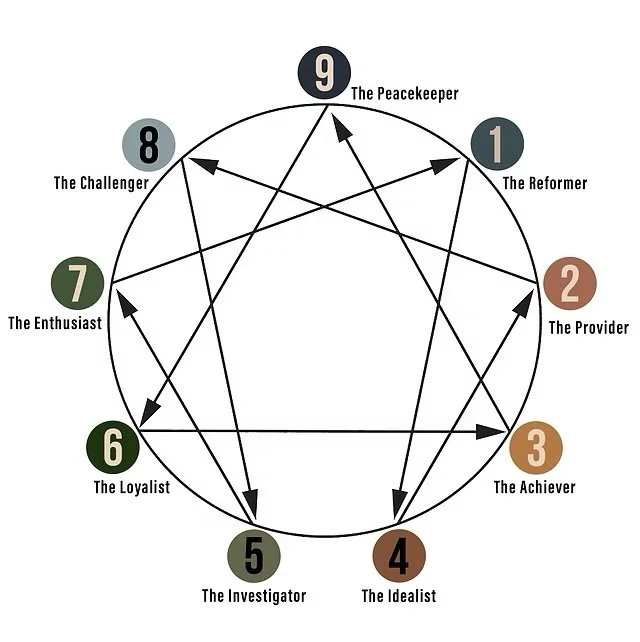
The Enneagram describes nine core strategies people develop to feel safe, worthy, and secure in the world.
It is:
About core motivations
Rooted in fear, desire, and longing
Focused on your default inner operating system
It is not:
A personality quiz
A mood snapshot
A list of behaviors
A measure of maturity or spirituality
Two people can behave the same way and be completely different types.
The Most Important Question (Don’t Skip This)
Instead of asking “What do I relate to?”
ask:
“What feels like it’s always running in the background of my life?”
Your type usually feels:
Uncomfortable to admit
A little exposed
Emotionally charged
Like something you’ve always carried
If a description makes you want to say, “I don’t want that to be true… but it is,” pay attention.
Narrowing It Down: Three Core Lenses
1. What Do You Fear Losing?
Each type has a core fear—not surface anxiety, but a deep concern that shapes decisions.
Ask yourself:
What would feel devastating if it were taken away?
What am I constantly guarding against?
What do I work hard to avoid feeling?
Clues:
Fear of being wrong → look at Ones
Fear of being unwanted → look at Twos
Fear of being worthless → look at Threes
Fear of having no identity → look at Fours
Fear of being depleted → look at Fives
Fear of being unsupported → look at Sixes
Fear of being trapped → look at Sevens
Fear of being controlled → look at Eights
Fear of conflict or loss of peace → look at Nines
2. What Do You Chase When You’re Stressed?
Under pressure, your type shows itself clearly.
Ask:
When life feels heavy, what do I default to?
Do I get more controlling, more withdrawn, more busy, more pleasing?
Stress doesn’t create your type—it reveals it.
Some people:
Tighten standards
Over-function for others
Perform harder
Withdraw into their mind
Scan for threats
Avoid pain at all costs
Push back aggressively
Disappear into comfort
Notice your pattern, not your intentions.
3. What Do You Long to Hear?
This is one of the clearest signals.
Which sentence feels like it hits your chest?
“You are good enough.”
“You are loved for who you are.”
“You don’t have to prove anything.”
“Your feelings matter.”
“You are capable and prepared.”
“You are safe.”
“You won’t be trapped.”
“You don’t have to be strong all the time.”
“Your presence matters.”
The message you long for most often points directly to your type.
Why You Might Relate to Multiple Types
That’s normal—and expected.
You may:
Share behaviors with several types
Have learned coping strategies from family or culture
Be in a season that activates stress patterns
Be healthy or unhealthy in ways that blur lines
The goal isn’t instant certainty. It’s honest observation over time.
Your true type becomes clearer when you notice:
Repeated emotional themes
The same conflicts showing up again and again
Familiar inner dialogue you can’t seem to escape
A Gentle Final Check
Your Enneagram type should not feel flattering.
It should feel revealing.
The right type often comes with:
Relief (“This explains so much.”)
Grief (“I’ve been carrying this a long time.”)
Compassion (“No wonder I do this.”)
If a type makes you feel seen instead of labeled—you’re close.
What to Do Next
If you’re still unsure:
Sit with 2–3 types for a few days
Read about their core fears, not just behaviors
Notice which one shows up most in stress
Pay attention to what feels hardest to let go of
Clarity doesn’t come from rushing.
It comes from honest self-awareness.
And when you find your type, it’s not the end of the journey—it’s the beginning of learning how to lead yourself with more compassion and intention.
Still Unsure? Let’s Figure It Out Together.
If you’ve narrowed it down to one or two types—but something still feels fuzzy—you don’t have to figure this out alone.
The Enneagram can be confusing when you’re trying to self-type, especially if:
You relate to multiple numbers
You’ve adapted for survival, not alignment
You’ve spent years functioning in stress mode
That’s exactly why I offer a free 30-minute Enneagram consultation.
This isn’t a test review or a surface-level chat.
It’s a guided conversation to help you:
Clarify your core motivation, not just behaviors
Understand what’s actually driving your patterns
Walk away with more self-compassion and direction
There’s no pressure, no pitch—just space to get clarity.
👉 [Book your free 30-minute consultation here]
Sometimes insight comes faster when someone is listening with you.